| Key Points | Details to Remember |
|---|---|
| 🌿 Adaptogenic Plant | Rhodiola rosea helps the body adapt to physical and mental stress |
| ⚖️ Precise Dosage | 300-600mg of standardized extract per day – adhere to the quantities |
| ⏱ Infusion Time | 10-15 minutes in water at 90°C for optimal extraction |
| 🌡 Critical Temperature | Avoid boiling water to preserve rosavins (active compounds) |
| 🔄 Recommended Cure | 6 to 12 weeks followed by a break – effectiveness proven by studies |
| ⚠️ Precautions | Consult a health professional if under medication |
Are you dragging a stubborn fatigue that resists coffee? Are your afternoons a battle against exhaustion? What if the solution grew on the cold slopes of Scandinavian mountains? Rhodiola, this little-known adaptogenic plant, could become your energy ally. But beware: poor preparation would spoil its precious components. After fifteen years of experience in phytotherapy, I share with you the exact protocol to make the most of every gram of dried root.
Sommaire
Understanding Rhodiola: Much More Than a Simple Stimulant
Unlike classic stimulants that drain your reserves, rhodiola rosea works by modulating your biological response to stress. Its key compounds – rosavins and salidrosides – optimize oxygen use by your cells. A study by the University of California showed it reduced fatigue by 31% in on-call doctors. Its secret? It supports your adrenal glands without overworking them.
In traditional Siberian medicine, it is called “golden root” – not for its color, but for its value. Russian cosmonauts used it as early as the 1960s to endure extreme space conditions. Today, the WHO recognizes its use as a “tonic during sensations of weakness.” But its effectiveness depends on careful preparation: heat the water too much, and you destroy up to 40% of its salidrosides.
The Two Types of Rhodiola: How to Choose
On the market, you will mainly find:
- Raw cut root – ideal for infusions but with a strongly earthy taste
- Standardized extract (often in capsules) – convenient but less suited for drinks
Favor organic certified products with at least 3% rosavins and 1% salidrosides – the ratio used in most clinical research. Beware of “energy” blends where rhodiola is only a secondary ingredient. For an infusion, dried loose root (not powdered) allows better extraction.
Necessary Equipment: The Art of Simplicity
No need to invest in expensive equipment. Here is what you really need:
- A kettle with thermostat (crucial for temperature control)
- A glass or porcelain teapot (metal alters the taste)
- A fine mesh filter or a stainless steel strainer
- A timer – precision makes the difference

Step-by-Step Tutorial: The Perfect Infusion
Step 1: Measure the Right Dose
For 250ml of water:
- 1 level teaspoon of cut root (about 0.8g)
- Or 300mg of standardized extract if you use opened capsules
Start with this amount in the morning for 3 days before possibly moving to two daily doses. Common mistake? Overdosing thinking “more effective”. However, a 2020 meta-analysis shows benefits plateau beyond 680mg/day.
Step 2: Heating the Water (The Secret Key)
Bring the water to 90-95°C maximum – simmering bubbles but no vigorous boiling. Why this precision? Rosavins degrade at 100°C. If your kettle has no thermostat, let boiling water rest for 30 seconds before use.
Step 3: Infusion Time and Covering
Pour the water over the rhodiola and cover immediately. Let infuse:
- At least 10 minutes – extraction of water-soluble compounds
- Ideally 15 minutes – complete release of salidrosides
Do not stir during infusion – this releases bitter tannins. Use a well-fitting lid to contain therapeutic volatile oils.
Step 4: Filtration and Tasting
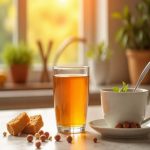
Filter carefully to remove particles. The brew will have an amber color and a characteristic woody aroma. Its taste? Earthy with a subtle bitterness. If necessary, sweeten with:
- 1/2 teaspoon of manuka honey (synergistic antibacterial)
- Or a slice of fresh ginger (stimulates bioavailability)
Avoid milk – its proteins inhibit absorption of active compounds.
When and How to Consume Your Energizing Infusion
Timing is strategic:
- Morning: 30 minutes before breakfast – optimal absorption on an empty stomach
- Midday: before 2pm – avoid sleep disturbances
For an effective course:
- Duration: minimum 6 weeks
- Schedule: 5 days out of 7
- Break: 2 weeks after each course
Effects generally appear after 3-4 days: increased mental endurance, less post-meal “slumps”. A Swedish study documented an 8% improvement in cognitive performance among students.
Common Mistakes and Troubleshooting Solutions
Problem: “My infusion tastes like mud”
- Solution: Reduce infusion time to 8 minutes or add peppermint
Problem: “I don’t feel any effect after a week”
- Solution: Check the concentration of rosavins (must be >3%) or slightly increase the dose
Problem: “The infusion gives me heartburn”
- Solution: Consume it after a light snack (banana or almonds) rather than on an empty stomach
Winning Combinations: Enhance the Effects
Rhodiola pairs wonderfully with:
- Eleutherococcus: for a natural “cortisone-like” effect
- Siberian ginseng: proven adaptogenic synergy
- Ashwagandha: combined for post-stress recovery
Avoid coffee within the hour afterward – caffeine strongly potentiates its effects in 20% of users.
Essential Precautions: Safety First
Absolute contraindications:
- Pregnancy and breastfeeding (insufficient data)
- Bipolar disorders (risk of agitation)
- Use of SSRI antidepressants (potential interactions)
Rare side effects (at excessive doses): dry mouth, slight agitation. As the European Pharmacopoeia reminds, “continuous use should not exceed three months.”
FAQ: Your Questions About Rhodiola Infusion
Can the infusion be reheated?
No – active principles degrade when reheated. Prepare it fresh every morning.
How long does the infusion keep?
Maximum 24 hours in the refrigerator in a sealed glass container.
Does rhodiola cause weight loss?
Indirectly: it reduces sugar cravings linked to stress but is not a fat burner.
Can I use it before sports?
Yes! Studies show a 3-5% improvement in endurance during exercise.
Is there any dependence?
No physical dependence observed, but a monthly break prevents tolerance.