Sommaire
Intro: why this craze?
Between 2020 and 2025, Google searches related to “adaptogenic mushrooms” exploded: +480% in France according to Google Trends, with a remarkable peak during Blue Monday 2025 (+92% in one week). At the same time, the Xerfi firm estimates the French market for fungal supplements at 48 million euros by the end of 2024, representing a +38% increase in two years. The reasons? First, pandemic fatigue, then the rise of remote work which blurred the boundaries between private and professional life – and finally, the media coverage of nootropics on social networks. Consumers are looking for natural solutions to boost immunity, focus, and energy without dependency.
1. Adaptogenic mushroom: simple definition
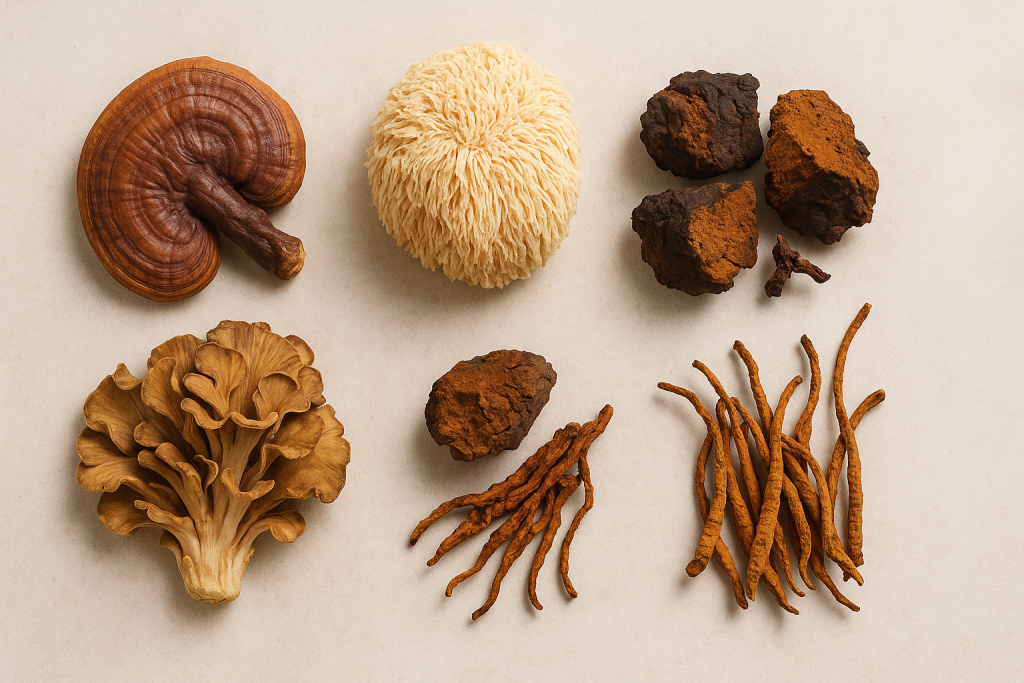
An adaptogenic mushroom is a fungal species capable of increasing the non-specific resistance of the body to physical, chemical, or biological stresses while restoring internal balance (homeostasis). The notion of adaptogen, coined by Russian pharmacologist Nicolaï Lazarev, requires:
- A general normalizing action on several systems (immune, endocrine, nervous).
- No toxicity or disruption of normal functions at therapeutic dosage.
- An identified mechanism of action: modulation of the HPA axis, reduction of cortisol, activation of NK cells, etc.
To go further: scientific criteria
To be recognized as an adaptogen by the European pharmacopoeia, the mushroom must demonstrate in at least two randomized clinical trials: (1) a significant effect on a stress biomarker (e.g., cortisol), (2) absence of cytotoxicity, (3) an elucidated pharmacokinetic profile. For example, the Nepalese Cordyceps is traditionally given to yak herders to climb passes at 4,000 m, while the red Reishi was reserved for Chinese emperors. Today, modern research uses cell models, RCTs, and metabolomic analyses to validate these uses.
2. Comparative table of the 5 stars
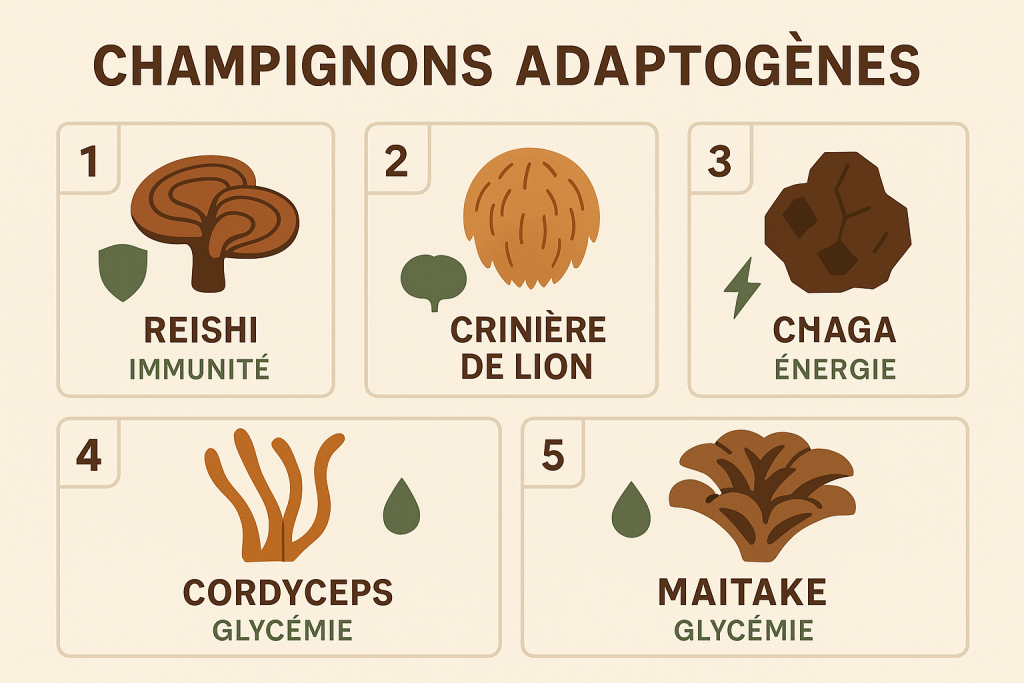
| Mushroom | Main Benefit | Active Compounds | Adult Dose (standardized extract) |
|---|---|---|---|
| Reishi | Immunity & Sleep | β‑1,3/1,6‑glucans, triterpenes (Ganoderic A‑Z) | 1 500 mg |
| Lion’s Mane | Memory & Mood | Hericenones A‑H, erinacines A‑S | 1 000 mg |
| Chaga | Antioxidant & Skin | Melanin, polyphenols, inotodiol | 2 000 mg |
| Cordyceps | Energy, VO₂max | Cordycepin, adenosine, polysaccharides CM‑P1 | 1 000 mg |
| Maitake | Blood Sugar | Fraction SX β‑glucan‑protein | 1 500 mg |
Tip: favor “dual” extracts (water + alcohol) to capture both water-soluble polysaccharides and fat-soluble triterpenes.
3. Proven Benefits in Humans
Adaptogenic mushrooms owe their effects to a synergy of immunomodulatory polysaccharides and secondary metabolites. Here are the strongest clinical evidences to date:
3.1 Immunity – Reishi
In a randomized controlled trial of 84 days (Foods, 2023, n = 72), 900 mg/day of β‑glucans from Ganoderma lucidum increased NK cells by +30 %[1], improved the CD4/CD8 ratio, and showed no liver or kidney toxicity.
3.2 Brain – Lion’s Mane
A double-blind study (2025, n = 88) showed that a standardized extract (1 g/day) of Hericium erinaceus improves working memory by 14 %
Although human trials are still rare, an open study (2002, n = 7) observed a 30 % decrease in fasting blood glucose after 2–4 weeks of SX fraction[4] of Grifola frondosa. A systematic review (Heliyon, 2024) concludes with “promising indications but heterogeneous data[5]” and calls for robust RCTs. Inonotus obliquus, the “diamond of Siberia,” concentrates a black melanin that absorbs free radicals. An in vitro study (Univ. Helsinki 2024) reduced oxidative damage by 43 % on keratinocytes exposed to UV‑B. Integrative dermatologists are already using a 2 g/day antioxidant latte to support atopic eczema, although human data are still awaited. ANSES recommends not exceeding 3 g/day of polysaccharides without medical supervision. The market is flooded with low-cost mycelial powders cut with cereals. My checklist: Pro tip: demand the COA: method Mushroom β‑D‑Glucan Assay at 425 nm, heavy metals (Pb < 0.5 ppm, Cd < 0.1 ppm, As < 0.1 ppm), mycotoxins < 2 µg/kg, digital signature. A reliable QR code links to this timestamped PDF. The extraction ratio (10 : 1, 20 : 1) only has value with a titration like “30 % polysaccharides including 20 % β‑glucans.” Find the detailed guide on Champizen: how to choose a good supplement. Is Reishi legal in France? Adaptogenic mushrooms form a versatile nutritional tool to support immunity, cognition, energy, and metabolism. Choose standardized extracts and consult your doctor if you are on sensitive treatment. Continue reading on Champizen: García‑Montero M. et al. Heliyon. 2024;10:e24567. DOI: 10.1016/j.heliyon.2024.e24567 Davinelli S. et al. Foods. 2023;12(3):659. DOI: 10.3390/foods12030659 Koga M. et al. Front Nutr. 2025;8:1405796. DOI: 10.3389/fnut.2025.1405796 Lee H‑J. et al. Sci Rep. 2024;14:58742. DOI: 10.1038/s41598‑024‑58742‑z Konno S. et al. Diabetes Res Clin Pract. 2001;52(3):183‑189. DOI: 10.1046/j.1464‑5491.2001.00532‑5.x3.5 Antioxidant & Skin – Chaga
4. Side effects & contraindications
5. How to choose a quality supplement?
6. Dosage & practical advice
Mushroom Daily dose Ideal time Cyclical break Reishi 1,500 mg Evening, after meal 1 week/8 Lion’s Mane 1,000 mg Morning on an empty stomach 2 weeks/12 Chaga 2,000 mg infusion < 85 °C Snack 1 month/3 Cordyceps 1,000 mg 30 min before sports 1 week/6 Maitake 1,500 mg Breakfast 2 weeks/10
7. FAQ – Frequently Asked Questions
Yes: registered as a dietary supplement since the EFSA opinion of December 14, 2022.
Can I combine several mushrooms?
Yes, while staying under 3 g of total β-glucans per day.
How long before the first effects?
2–6 weeks depending on the goal (cognition is faster than blood sugar).
Can children take it?
No, due to lack of robust clinical data for those < 18 years old.
Risk of doping with Cordyceps?
Standardized extracts are absent from the WADA list; caution with enriched adenosine.
Do adaptogenic mushrooms replace a treatment?
No, they complement medical care and should never alter a protocol without advice.Conclusion & Call to Action
References