
| Key Points | Details to Remember |
|---|---|
| 🌿 Origin | Extracted naturally from green tea |
| ⏱ Latency | Reduces the delay before falling asleep |
| ⚖️ Dosage | 250–400 mg per dose according to studies |
| 🧠 Mechanism | Modulation of GABAergic activity |
| 🔄 Comparisons | Gentle alternative to melatonin |
| ⚠️ Precautions | Avoid during pregnancy without medical advice |
| ✔️ Tips | Combine with a relaxation routine |
Do you spend long minutes tossing and turning before Morpheus deigns to welcome you? L-theanine, an amino acid isolated from green tea, may surprise you with its ability to soothe the mind and accelerate crossing the threshold of sleep. Here, we explore how to dose this supplement precisely, relying on clinical data and concrete feedback, so that the wait for sleep becomes much shorter.
Sommaire
Understanding L-theanine
Origin and mode of action
Discovered in the 1940s, L-theanine mainly comes from Camellia sinensis, the plant behind green tea. Unlike caffeine, it does not stimulate; it acts rather as a subtle calming agent. After ingestion, it quickly crosses the blood-brain barrier and modulates the production of key neurotransmitters: it increases serotonin and GABA while tempering dopamine effects in certain brain areas. The result: a state of mental relaxation without excessive daytime sleepiness.
Effects on the brain and sleep
Several researchers have demonstrated an average reduction in sleep onset latency of 20 to 30 minutes thanks to L-theanine. By acting on alpha waves, it promotes a state comparable to light meditation, where the mind slows down without immediately switching to deep sleep. You gain this precious period where the mind can disconnect before the sleep phase, thus avoiding ruminative tendencies.
Precise dosage to reduce latency
Clinical Studies and Standard Dosages
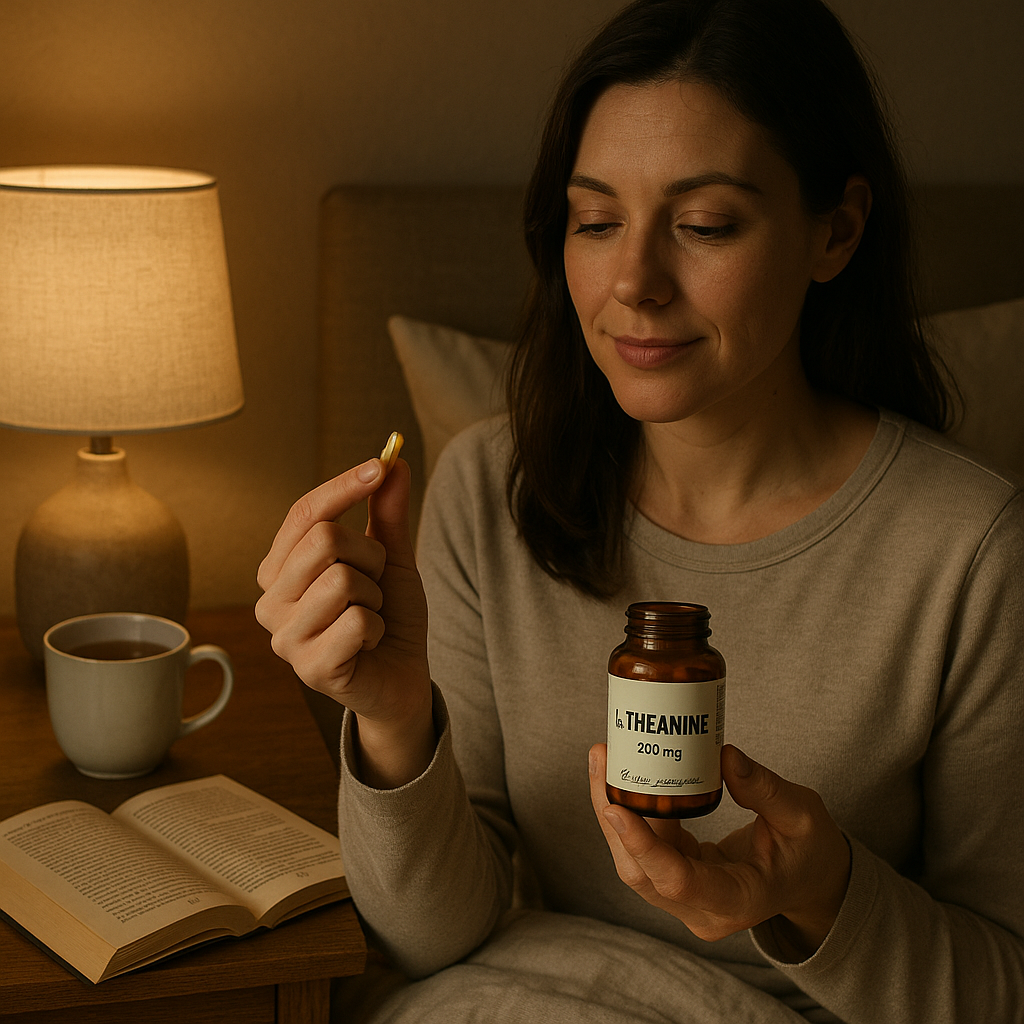
According to a study published in Nutrients (2020), a single administration of 200 mg of L-theanine before bedtime significantly reduces the time it takes to fall asleep in adults with mild insomnia. Other protocols suggest going up to 400 mg for more resistant cases, with no reports of severe side effects. In practice, one often starts at 100 mg to test sensitivity, then gradually increases until feeling an inner calm conducive to sleep.
Adapt According to the Individual
Each body reacts differently. A person weighing 50 kg and another weighing 90 kg will not have the same pharmacokinetics: L-theanine is water-soluble, and its absorption can slightly vary depending on gastric content. If you notice too mild an effect, increase to 300 mg, but remain vigilant about the quality of your deep sleep and recovery the next day.
Combine with Other Strategies
To maximize results, L-theanine can be paired with breathing exercises or a gentle yoga session. Some dosing protocols also borrow approaches from phytotherapy or adapt dosing protocols inspired by CBD: the idea is not to stack molecules, but to create an environment conducive to relaxation on multiple levels.
Comparisons and Precautions
Compared to Melatonin
Melatonin directly targets the circadian clock, while L-theanine acts on neuronal chemistry. Both can be complementary: the former signals the brain that it is time, the latter helps it to calm down. However, melatonin can shift your clock if poorly dosed, whereas L-theanine does not alter your chronotype.
Interactions and Limitations
If you are taking anxiolytic or antidepressant treatment, inform your doctor about taking L-theanine. Data on coexistence with certain psychotropics remain fragmented. Furthermore, pregnancy and breastfeeding lack robust studies: a natural sleep memory or other non-pharmacological methods are preferred during these periods.
Practical Tips for Optimal Intake
- Timing: 30 minutes before bedtime, to allow the amino acid time to reach the brain.
- Method: on an empty stomach or after a light snack (plain yogurt, caffeine-free herbal tea).
- Ritual: accompany with gentle reading or guided meditation to enhance the relaxing effect.
- Hydration: drinking a small glass of warm water improves dissolution and absorption.
- Monitoring: note the quality and time to fall asleep in a journal for 2 weeks to adjust the dosage.
Frequently Asked Questions
Does L-theanine create dependence?
No study indicates a risk of tolerance or addiction. It differs from traditional sleeping pills by its non-sedative profile.
Can I take L-theanine every night?
Yes, daily use at moderate doses (200–300 mg) does not seem to pose a problem, provided you monitor your feelings and daytime alertness.
Is it compatible with other sleep supplements?
It can be combined with melatonin or magnesium, but avoid testing several new products simultaneously to clearly identify what works.
What effects to expect in the first week?
Some feel calm from the first days, others after 7–10 days as the brain rhythm adjusts. Patience often pays off.