| Key Points | Details to Remember |
|---|---|
| 📖 Definition of CBD | Understand the origin, molecular profile, and legal status of cannabidiol. |
| ⚙️ Components of the ECS | Identify the CB1/CB2 receptors, endocannabinoids, and degradation enzymes. |
| 🔬 Mechanisms of Action | Modulate receptors, enzymes, and neurobiological pathways for a potentially therapeutic effect. |
| 💪 Key Benefits | Improve pain management, anxiety, sleep, and inflammatory response. |
| ⚠️ Precautions | Follow recommended dosages and check for drug interactions. |
| 📚 Sources and Studies | Consult pharmacopoeia publications and clinical reviews for more evidence. |
Cannabidiol, widely referred to by its acronym CBD, is generating growing interest both among researchers and the general public. Derived from Cannabis sativa, this non-psychoactive compound differs from its THC counterpart, offering intriguing therapeutic possibilities. To grasp the impact of CBD on our body, it is essential to delve into the architecture of the endocannabinoid system (ECS), a true conductor of internal balance. This article guides you step by step through molecular mechanisms, key interactions, and health benefits validated by research.
Sommaire
Understanding the Endocannabinoid System
Origins and Discovery
In the 1990s, Israeli pharmacologist Raphaël Mechoulam first identified delta-9-THC, paving the way for the study of the endocannabinoid system. This complex network, now recognized in the European Pharmacopoeia, regulates numerous physiological processes. Rather than being a simple neuronal “channel,” the ECS acts as a global modulator, adapting the body’s response to internal and environmental changes.
Key Components of the ECS
Three categories of elements form the ECS:
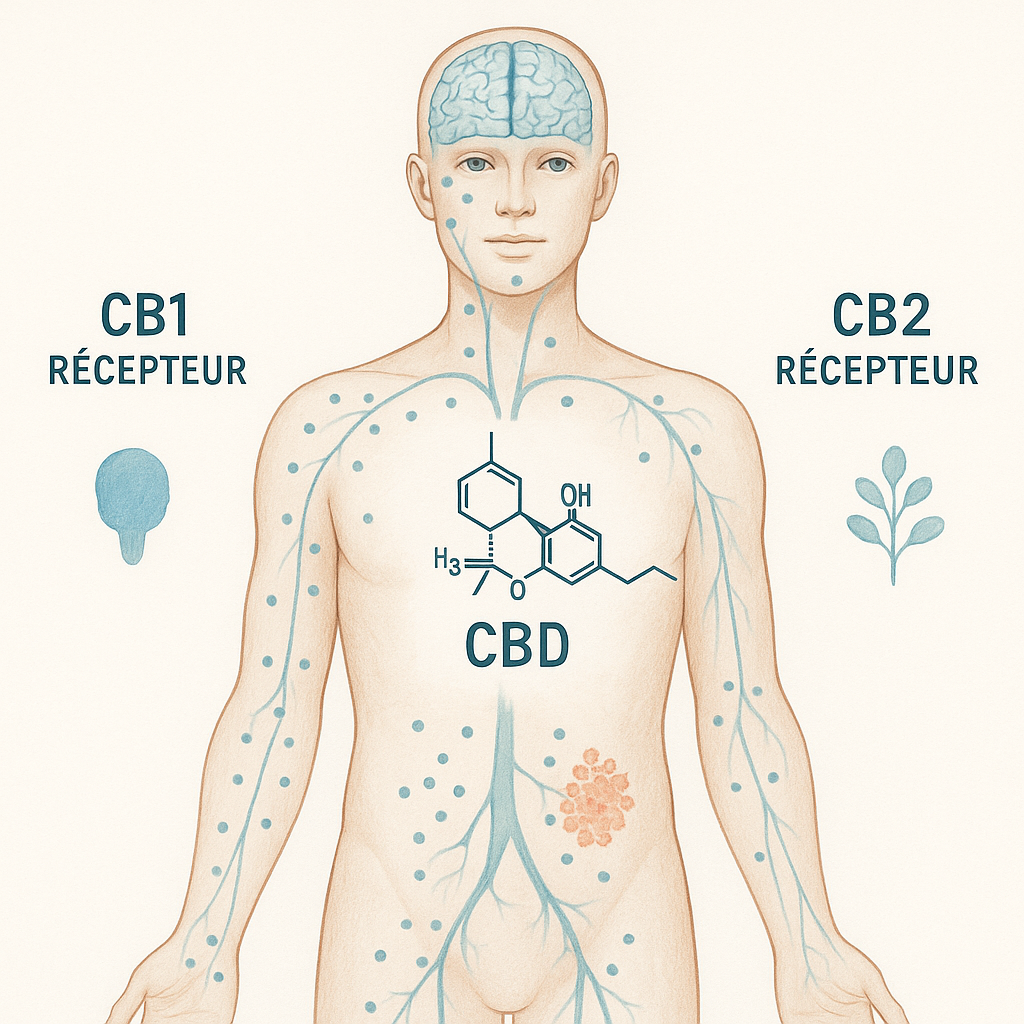
- The receptors: CB1, mainly in the central nervous system, and CB2, mostly present in immune tissues.
- The endocannabinoids: anandamide and 2-AG, molecules produced on demand to rebalance cellular activity.
- The enzymes: FAAH and MAGL, responsible for degrading endocannabinoids after their action.
Each of these elements continuously interacts to preserve homeostasis, a delicate balance between stress, inflammation, and vital functions.
Cannabidiol (CBD): Profile and Functioning
Chemical Structure and Sources
The CBD molecule is characterized by a four-ring skeleton, without the psychoactive group of THC. Generally extracted by supercritical CO₂ method, it benefits from controlled purity, compliant with pharmacopeia standards. Although hemp contains several cannabinoids, CBD often represents 40 to 50% of the total profile when produced by dedicated extraction.
Interaction with the Endocannabinoid System
Unlike THC, CBD does not bind directly to CB1 or CB2 receptors as an agonist. Instead, it acts as an allosteric modulator: it amplifies or attenuates receptor responses while inhibiting FAAH, the enzyme that degrades anandamide. The result? A prolonged level of endocannabinoids in the brain, affecting mood, pain, and appetite without euphoric effects.
Mechanisms of Action of CBD
Receptor Modulation
CBD also influences other targets such as TRPV1 receptors (heat and pain), serotonin 5-HT1A (anxiety regulation), and PPAR receptors (cellular metabolism). This versatility explains why it attracts attention as a neuroprotective and anti-inflammatory agent.
Influence on Enzymes
By inhibiting FAAH, CBD prevents the rapid degradation of anandamide, already nicknamed the “happiness molecule.” Clinical studies published in the Journal of Clinical Medicine demonstrate that this action prolongs anxiolytic and analgesic effects.
Potential Health Benefits
- Pain Management: clinical trials observe a significant reduction in chronic pain, notably neuropathic pain.
- Anxiety Reduction: by modulating the serotonergic circuit, CBD helps alleviate anxiety attacks and post-traumatic stress.
- Sleep Improvement: longer-lasting and restorative sleep, confirmed by polysomnographic recordings.
- Anti-inflammatory Action: relevant for arthritis, dermatoses, or autoimmune diseases.
- Neuroprotection: research explores its interest in Parkinson’s disease and multiple sclerosis.
Of course, these results still need to be clarified through larger-scale trials, but they open promising perspectives.
Precautions and Recommendations
Before integrating CBD into your routine, a few points deserve attention. First, product quality: prefer lab-tested extracts, ensuring absence of pesticides or heavy metals. Next, dosage: start low (5–10 mg/day) and adjust gradually. Finally, potential interactions: CBD can influence hepatic metabolism of certain drugs (via cytochrome P450), hence vigilance is essential in case of chronic treatment.
FAQ
What is the endocannabinoid system?
It is a network of receptors, endocannabinoids, and enzymes responsible for maintaining physiological balance in the body.
How does CBD interact with the ECS?
CBD modulates receptors and inhibits degradation enzymes, prolonging the effect of natural endocannabinoids.
Does CBD have side effects?
Side effects are generally mild (dry mouth, fatigue). But it can interfere with certain medications via the liver.
Is CBD legal?
In Europe, CBD derived from hemp containing less than 0.3% THC is authorized, subject to compliance with local regulations.
How to choose a good CBD product?
Prefer a broad or full spectrum, derived from a CO₂ extraction, with an independent certificate of analysis.