| Key Points | Details to Remember |
|---|---|
| 🌾 Definition | Fibers derived from seeds or plant extracts providing digestive benefits. |
| 💪 Main Benefits | Regulation of transit, feeling of fullness, and microbiota balance. |
| ⚙️ How It Works | Gelling and water adsorption capacity, depending on soluble/insoluble nature. |
| 🔍 Usage Methods | Incorporation into yogurts, smoothies, breads, or as a powder supplement. |
| 📊 Practical Applications | Control of blood sugar, weight management, and support of intestinal comfort. |
| ⚠️ Precautions | Hydration essential and gradual start to limit bloating. |
Fibers, these often overlooked allies, nevertheless hold a central place in our diet. Between chia seeds, flax seeds, inulin powder, and psyllium, each source has its own personality: some swell, others feed our intestinal bacteria. Throughout this article, we dissect their profile, weigh the advantages, and do not forget the limits to watch, to choose with full awareness.
Sommaire
Dietary fibers at the heart of seeds
Beyond the simple mechanical role on transit, fibers participate in a complex metabolic balance. We distinguish two main families: soluble fibers that form a gel upon contact with water, and insoluble fibers that pass almost intact. This duality influences both digestion and the glycemic response after a meal.
Looking at chia and flax seeds, they contain a significant proportion of insoluble fibers, useful for “sweeping” the digestive tract. In parallel, psyllium and inulin are rather on the soluble side, with the capacity to absorb up to 10 times their weight in water. This gelling phenomenon is precisely exploited to slow sugar absorption and prolong satiety.
Soluble fibers vs insoluble fibers
The former swell and form a viscous barrier, slowing intestinal passage. The latter accelerate transit by increasing stool volume. Neither is dispensable: ideally, a combined intake optimizes digestive comfort. The guarantees of a diverse microbiota often come from fermentable soluble fibers like inulin, which feed our “good” bacteria.
Chia seeds: small but powerful
Originating from Central America, salvia hispanica has established itself as a nutritional booster. In addition to a remarkable omega-3 profile, these small seeds provide 34% fiber, mostly insoluble. They turn into a gel upon contact with liquid, offering an interesting texture for porridges or pudding.
On the benefits side, they promote intestinal regularity, help stabilize post-meal blood sugar levels, and can be a boost for weight management. However, their gelled cuticle can trap too much water if the dry seed is consumed without caution, hence the risk of discomfort if hydration is insufficient.
Flax seeds: an ancestral ally
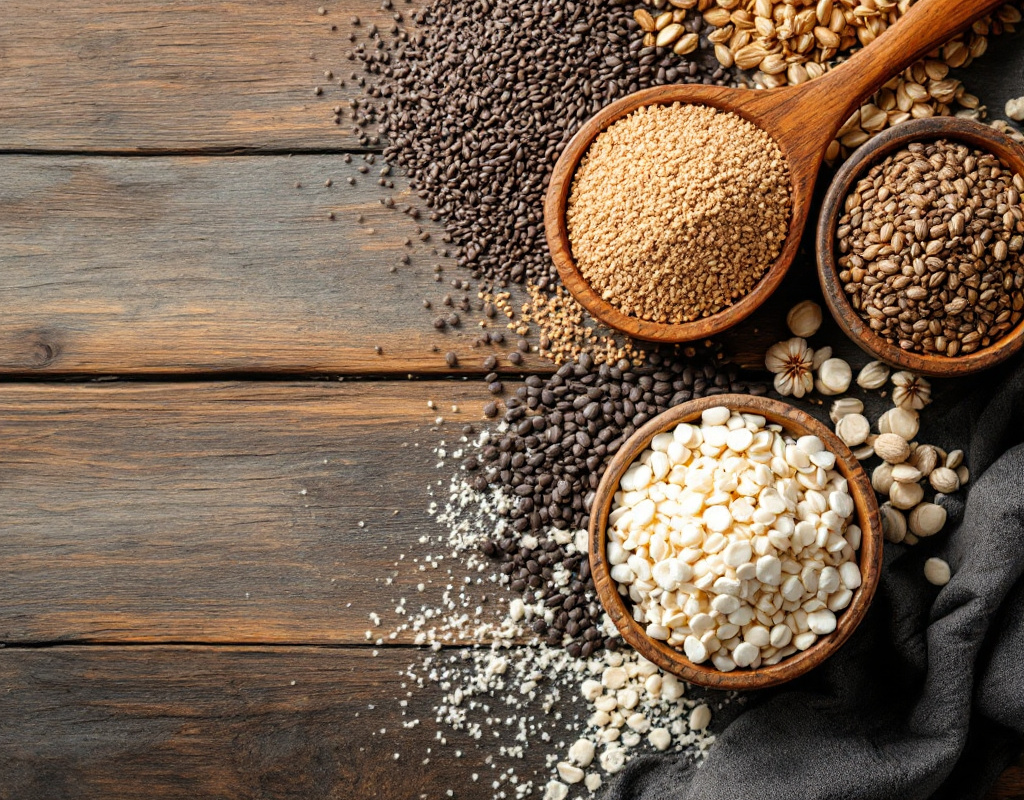
Golden or brown flax stands out for its profile rich in lignans, specific antioxidants. Ground shortly before consumption, the seeds release their essential fatty acids and provide 27% fiber, divided between soluble and insoluble. Grinding is crucial: without it, the body cannot access the enclosed nutrients.
Adding ground flax to yogurts or homemade breads is a simple way to diversify fiber intake. However, consumed in excess, flax can cause bloating or an overly strong laxative effect. A daily dose of 1 to 2 tablespoons is enough to enjoy its virtues without discomfort.
Inulin: the prebiotic fiber
Extracted from chicory or agave, inulin proves to be an fermentable fiber ideal for stimulating the gut flora. It dissolves easily in water, adds a slight sweet taste, and can serve as a natural thickener. Its nearly zero glycemic index makes it popular in lightened products.
Studies show that moderate consumption — around 5 to 10 g per day — promotes the multiplication of beneficial bifidobacteria. But beyond that, inulin can cause gas and bloating. It is therefore advisable to introduce it gradually and respect individual tolerance.
Psyllium: the ultimate gelling effect
Psyllium husks stand out for their extraordinary absorption capacity: up to 20 times their weight in water. This 100% soluble fiber forms a thick gel, used to regulate slow or fast transit. Its effectiveness is validated by numerous pharmacopoeial studies.
In the blonde version, psyllium has a neutral flavor and a fine granularity. To refine your knowledge of this plant treasure, discover our complete guide on blonde psyllium, where dosages, usage methods, and precautions to observe are detailed.
However, be careful to properly hydrate the preparation and start with small amounts: a too sudden intake may cause blockages if the gel is not followed by a sufficient glass of water.
Comparative table of nutritional contributions (per 100 g)
| Source | Total fibers | Soluble / Insoluble |
|---|---|---|
| Chia | 34 g | 5 g / 29 g |
| Flax | 27 g | 7 g / 20 g |
| Inulin | 90 g | 90 g / 0 g |
| Psyllium | 80 g | 80 g / 0 g |
Tips for integrating these fibers daily
- Start slowly: half a teaspoon of inulin or psyllium before gradually increasing.
- Prefer ground seeds (flax, chia) for better bioavailability.
- Combine them with sufficient hydration: each gram of fiber requires 10 mL of water.
- Mix them into smoothies, yogurts, soups, or breads; they lend themselves to many recipes.
- Vary the sources to benefit from the full range of prebiotics and omega-3s.
FAQ
How much chia seed should be consumed daily?
As a general rule, 15 to 20 g (one to two tablespoons) is enough to enjoy their benefits without risking digestive discomfort. Don’t forget to rehydrate them before ingestion.
Is psyllium suitable for a ketogenic diet?
Yes, psyllium is very low in net carbohydrates and can be easily included in a ketogenic diet to improve intestinal regularity.
Can inulin and flax seeds be combined?
It is perfectly possible, provided the doses are adjusted. Inulin feeds the flora, while flax provides omega-3 and lignans. Introduce them gradually to avoid discomfort.