
Natural laxatives offer a gentle and often well-tolerated alternative to stimulate intestinal transit. This comparison reviews 7 plants and seeds recognized for their effectiveness, details the recommended dosages, and highlights possible side effects.
Sommaire
In brief
🕒 7 natural solutions scrutinized: psyllium, prunes, aloe vera, flax seeds, cascara sagrada, rhubarb, and senna.
🍃 The ingredients vary between bulk-forming (psyllium, flax seeds) and stimulants (cascara, senna), acting within 6 to 48 hours.
⚖️ Clear dosages: from 5 g per day of psyllium to 1 g of senna, adjustable according to tolerance.
🚨 Side effects to watch for: bloating, cramps, electrolyte imbalance. See our guide on overdose risks.
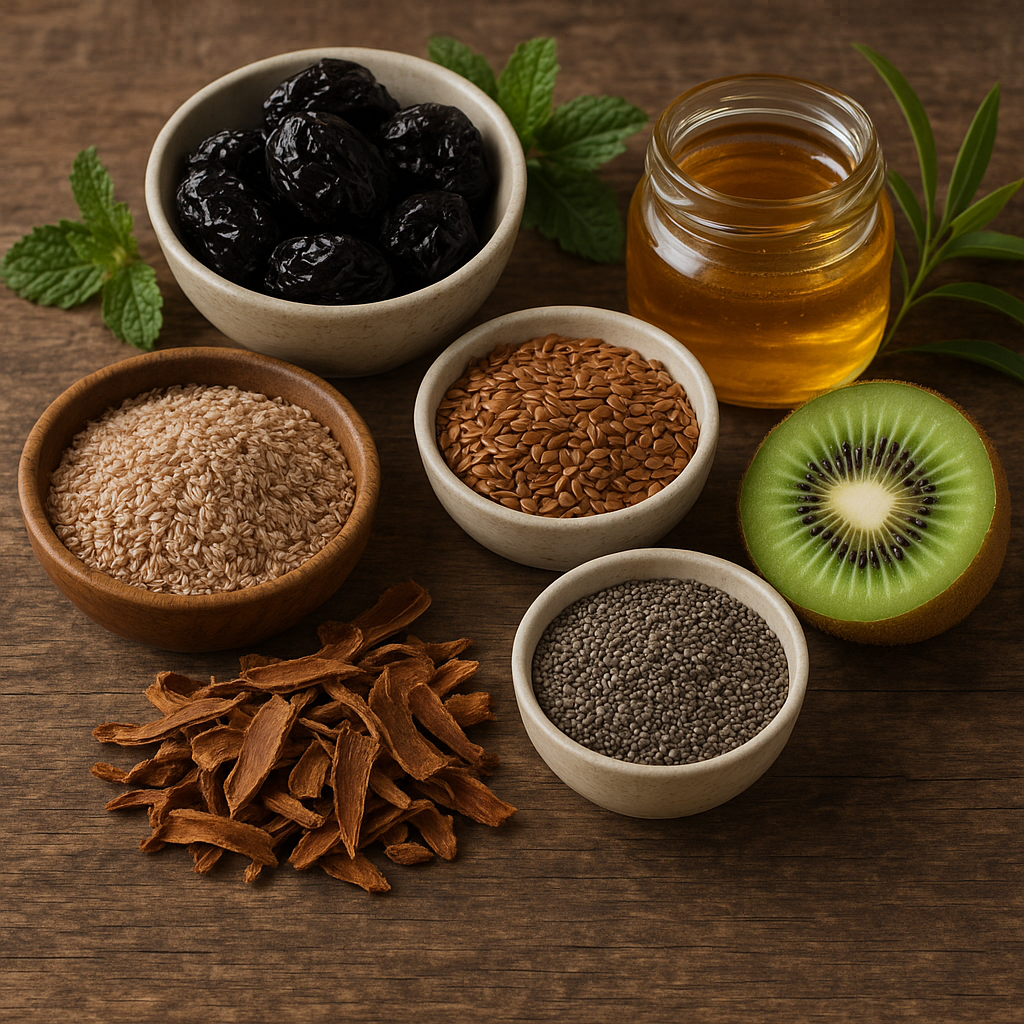
The 7 best natural laxatives compared
Psyllium: the swelling fiber
This soluble fiber, derived from the husks of Plantago ovata, acts as a bulk-forming agent: it retains water, swells in the intestine, and facilitates stool passage. The effect appears within 12 to 24 hours, ideal for preventive use in chronic constipation.
- Dosage: 5 g to 10 g, 1 to 2 times per day, mixed with water.
- Advantage: regulates transit without stimulating the mucosa.
- Limitation: possible bloating, drink plenty of water.
Prunes: the fruity sweetness
Prunes contain sorbitol and a high concentration of insoluble and soluble fibers. They trigger an osmotic and mechanical action, with an average delay of 24 hours. Their sweet taste facilitates adherence, especially in children.
- Quantity: 4 to 6 fruits per day, soaked if needed.
- Plus: antioxidant content, contributes to intestinal health.
- Watch out: diarrhea if overdosed on sorbitol.
Aloe vera: stimulating gel
Aloe vera gel is used in short cures (5 to 7 days). The presence of anthraquinones confers a stimulating effect on the intestinal muscles, with an action delay of 8 to 12 hours. Its bitter taste can be masked in juice or a smoothie.
- Dosage: 30 to 60 ml of pure gel, morning on an empty stomach.
- Benefit: local anti-inflammatory action.
- Warning: abdominal spasms, use not recommended during pregnancy.
Flax seeds: lubrication and swelling
These seeds are rich in mucilages. When in contact with water, they form a lubricating gel that promotes flow. The effect appears within 12 to 24 hours. They can be consumed ground or whole, but grinding improves absorption.
- Recommendation: 1 to 2 tablespoons per day, to be mixed into yogurt or applesauce.
- Advantage: supply of omega-3 and lignans.
- Limit: risk of obstruction if poorly hydrated.
Cascara sagrada: the powerful inducer
Originating from North America, cascara bark contains anthraquinones that cause contraction of the colonic muscles within 8 to 10 hours. Short courses (max. two weeks) are preferred to avoid habituation.
- Standard dosage: 300 mg to 600 mg of dry extract, taken once.
- Strength: rapid efficacy for refractory constipation.
- Side effects: intense cramps, potassium imbalance.
Rhubarb: natural relay
Rhubarb roots (Rheum palmatum) contain anthraquinones similar to those in cascara. They stimulate water secretion and colonic activity, with an effect in 10 to 15 hours. To be used in limited courses of up to 7 days.
- Dosage: 500 mg to 1 g of dry extract.
- Asset: milder flavor than other anthraquinones, better tolerance.
- Monitoring: risk of urine discoloration, muscle weakness.
Senna: the traditional anti-constipation
Senna leaf (Cassia angustifolia) contains emetine and sennoside glycosides, which directly stimulate the colonic mucosa. The action starts between 6 and 12 hours. Used since Antiquity, it remains a classic for short courses.
- Dosage: 1 g of dry extract, often taken once before bedtime.
- Strong point: reliable onset time for occasional use.
- Precaution: do not exceed 7 consecutive days to limit dependence.
Comparative table of laxatives
| Laxative | Onset time | Dosage | Major side effect |
|---|---|---|---|
| Psyllium | 12–24 h | 5–10 g/day | Bloating |
| Prunes | 24 h | 4–6 fruits | Osmotic diarrhea |
| Aloe vera | 8–12 h | 30–60 ml | Cramps |
| Flax seeds | 12–24 h | 1–2 tbsp | Obstruction |
| Cascara sagrada | 8–10 h | 300–600 mg | Potassium imbalance |
| Rhubarb | 10–15 h | 500 mg–1 g | Urine discoloration |
| Senna | 6–12 h | 1 g | Dependence |
How to choose your natural laxative?
Your choice depends on the consistency of the constipation, your sensitivity, and the desired duration of the course. Bulk-forming (psyllium, flax seeds) are suitable for chronic disorders, while anthraquinones (cascara, senna, rhubarb) target occasional or refractory situations. Always include a hydrating and fiber-rich diet to enhance efficacy and limit dependence. If severe abdominal pain occurs, adjust the dose or change the plant.