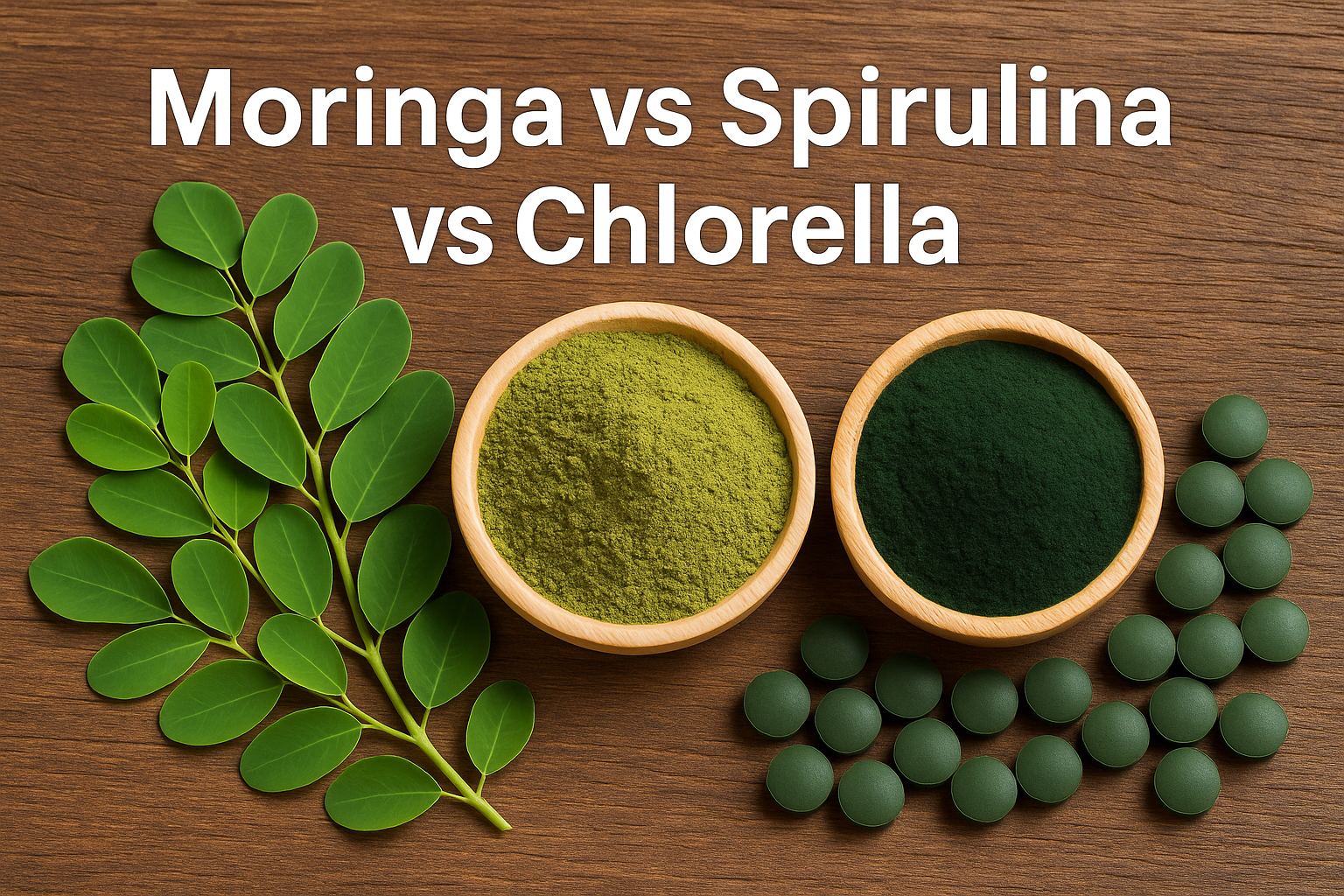
Are you lost among all the superfoods making the buzz? Don’t panic. Today, we’re putting three heavyweights of wellness in the ring: moringa, spirulina, and chlorella. All are rich in nutrients, all promise to boost your vitality… but each has its own particularities. Which one is right for you?
Make yourself comfortable, we’ll explain everything. Accessible, punchy version, and of course, EEAT approved 💪
Round 1: origin and composition 🌍
To understand their differences well, let’s start with their origins. Moringa grows on tropical trees in India and Africa, often cultivated in rural areas where it is used as a survival food. You often see entire families harvesting the leaves, gently drying them in the sun, then grinding them into powder. It doesn’t get simpler or purer than that. Its leaves are a goldmine: they concentrate essential vitamins like A, C, and E, iron in large amounts, and a calcium + magnesium combo that’s hard to beat.
Spirulina, on the other hand, is a blue-green microalga found in alkaline lakes in Africa or South America. It has been known since the Aztecs, who used it as a protein source during long expeditions. And it’s justified: with nearly 70% assimilable protein, it’s a powerhouse for athletes or vegans.
As for chlorella, its green cousin, it also grows in freshwater. But what sets it apart is its rigid cell membrane, capable of binding to toxins and heavy metals. In short, it’s a living sponge.
👉 Verdict: moringa shines on vitamins, spirulina is the queen of proteins, and chlorella, the detox champion.
Round 2: main benefits ✅
Each superfood has its specialty, and their use depends on what you are looking for. Moringa is a real boost for immunity. It is used in several humanitarian programs to fight child malnutrition. It also helps stabilize blood sugar, a crucial point for people suffering from type 2 diabetes. Some studies have even shown an improvement in lipid profile and a decrease in triglycerides after a few weeks of consumption.
Spirulina is the secret weapon of athletes: faster recovery, reduced cramps, better endurance. It is also a natural remedy against anemia. Many women report a marked improvement in their energy levels after a course. Sarah, a yoga teacher in Lyon, says she has never needed an iron supplement since she started adding it to her morning smoothies.
Chlorella, for its part, works wonders after a period of intense stress, heavy treatment, or a diet too rich in processed foods. It helps cellular regeneration and acts as a natural filter.
👉 The idea is to choose according to your main need. Fatigue? Spirulina. Immunity? Moringa. Detox after excess? Chlorella.

Round 3: digestibility and side effects ⚠️
We often talk about the benefits, but we also need to mention the downsides. Moringa is generally very well tolerated, except in cases of overconsumption. Some people experience mild nausea or bloating when they start too aggressively. The best practice? Start with half a teaspoon and increase gradually.
Spirulina can also cause slight discomfort: headaches, nausea, “detox” effects. This is often temporary and related to the release of toxins.
Chlorella is the most sensitive. If you take it without caution, it can cause quite strong digestive reactions: bloating, gas, even intestinal discomfort. Its thick membrane can complicate digestion, unless you opt for the broken cell wall version.
👉 Tip: always start with small doses and stay well hydrated to facilitate adaptation.
Round 4: how to consume them? 🍽
This is not a taste competition here, but let’s be honest: some of these superfoods are easier to swallow than others. Moringa has a grassy taste that works well in a smoothie, especially if sweetened with banana or mango. You can also add it to soups or even salad dressings.
Spirulina has a fairly strong marine flavor. Some love it, others avoid it. In tablets, it’s more neutral. In powder form, mix it into vegetable juice or a cold soup.
Chlorella, frankly, is not the most glamorous. Its taste is very vegetal, almost earthy. The best solution is often capsules, taken as a short-term cure.
Round 5: price and accessibility 💸
- 💰 Moringa: between €15 and €25 for 200g of organic powder, often produced in cooperatives in Africa or India.
- 💸 Spirulina: more concentrated, therefore more expensive. French artisanal versions are around €30 for 100g.
- 💵 Chlorella: often imported from Asia, but quality “broken” versions (more digestible) easily cost €35 for 200g.
👉 Tip: always check the origin, organic labels, and production methods (low-temperature drying, absence of heavy metals, etc.).
In conclusion: which one to choose? 🎯
No death match here. These three superfoods can coexist in your routine. The key is to know what you are looking for.
- Daily support? Moringa is ideal.
- A boost before or after sports? Spirulina all the way.
- A seasonal detox desire? Chlorella is your ally.
And if you hesitate? Alternate! One month one, one month the other. Or try a gradual mix, starting slowly. Listen to your body; it will tell you what feels good.
FAQ Comparison ❓
Can I combine spirulina, moringa, and chlorella? Yes, by alternating or in small combined doses. Be careful not to exceed the recommended daily doses.
Does spirulina contain B12? Yes, but its form is poorly assimilated. It does not replace a real active B12 supplement.
Are there any contraindications? Yes: pregnant women, children under 3 years old, and people under medication should consult their doctor.
What does spirulina taste like? Strong, iodized, marine. Best masked in a juice or cold soup.
Can I give these superfoods to my child? In moderation, from 4-5 years old, under medical supervision.
Where to buy these products? In organic stores, specialized websites, or directly from local producers (artisan French spirulina, ethical moringa, certified chlorella).