
| Key Points | Details to Remember |
|---|---|
| 🛒 Purchase Choice | Reliable selection from a supplier, verify origin |
| 📦 Initial Storage | Airtight packaging prevents air and moisture |
| 🌡️ Ideal Temperature | Range 5–20 °C depending on form |
| 💧 Humidity Control | Rate ideal between 45% and 60% |
| 📅 Shelf Life | Duration fresh 3–5 days, dried several months |
| 🔍 Periodic Check | Weekly visual inspection to detect mildew |
Adaptogenic mushrooms are appealing for their benefits on stress, immunity, and energy. But once the purchase is made, the puzzle arises: how to store them without losing their active compounds, how long to keep them, and what signs indicate deterioration? This article raises the essential questions and offers detailed answers, drawn from harvesting experiences, laboratory studies, and feedback from knowledgeable users.
Sommaire
How to choose and buy your adaptogenic mushrooms?
Quality Criteria and Traceability
Origins play a decisive role: mushrooms come from organic farms in Europe as well as wild species collected in Asia. Above all, favor a supplier transparent about the species (Reishi, Cordyceps, Chaga, etc.), their cultivation method, and contaminant analysis. An organic certification or a third-party test indicating absence of heavy metals guarantees a safer product, especially if you consume several grams per day.
Available Forms and Formats
Fresh, dried, liquid extract, powder, capsules… each presentation affects concentration and ease of use. Fresh mushrooms retain the maximum amount of volatile compounds but perish within a few days. Powders and concentrated extracts offer longer stability and precise dosing. For an introduction to the benefits of Reishi, a standardized extract is often recommended. You can consult our adaptogenic mushrooms buying guide to compare formulas and dosages.
Initial Storage After Purchase
Upon Receipt of Fresh Products
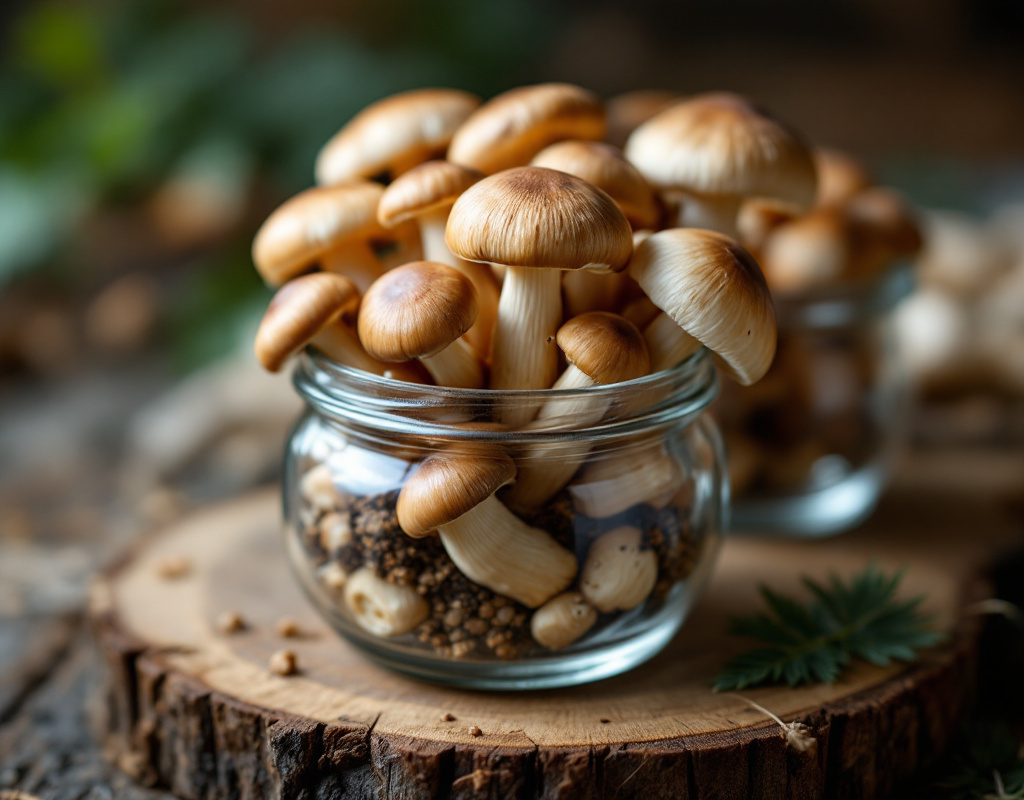
When a package arrives with fresh mushrooms or hydrated mycelium, the most instinctive reaction is to store them at the back of the refrigerator. However, ambient humidity, often above 90%, promotes mold growth. Transfer them to an airtight container lined with absorbent paper that you will replace every two days.
Upon Receipt of Dried or Powdered Products
Dehydrated or powder forms require a dark space, protected from direct light and heat. A kitchen cupboard away from the stove is perfect. Keep the powder in its original pouch, or transfer it to a glass jar with a silicone seal. The key is to limit back-and-forth: each opening exposes the contents to outside air.
Medium and Long-Term Storage
Preservation of Dried Mushrooms
Proper dehydration (residual moisture content below 10%) allows most active compounds to be preserved for up to 12 months. To enhance this stability, add a small food-grade silica gel packet and regularly check its integrity. A quick test is to press a mushroom between two fingers: if it squeaks, the drying is satisfactory.
Powders, Tinctures, and Concentrated Extracts
Aqueous or alcoholic extracts have the advantage of preserving both water-soluble and fat-soluble molecules. Stored in amber bottles, these products remain stable for 18 to 24 months, provided the dropper is closed with a clean dropper cap. Standardized powders, on the other hand, can fragment due to ambient humidity; an airtight jar remains the best protection.
Capsules and Gelatin Capsules
The capsule format is intended for those seeking quick dosing, without taste or preparation. All brands recommend keeping them away from heat and light. You can optimize their shelf life by storing your boxes in a cool drawer, around 15 °C. Humidity is less critical than for fresh products, but a poorly closed bottle will gradually absorb moisture.
Shelf Life and Signs of Deterioration
How long can each form be stored?
- Fresh: 3 to 5 days in an airtight container, refrigerated.
- Dried: 6 to 12 months in a sealed jar with silica gel.
- Powder/extract: 18 to 24 months depending on packaging and sealing.
- Capsules: 12 to 18 months away from direct light.
How to spot a spoiled product?
A fading color, a damp or moldy smell, and sometimes a slimy texture: all warning signs. Spores of certain species (such as Chaga) tend to generate a fine black film on the surface, different from the original caps. Finally, an intensified bitter taste may indicate oxidation of phenolic compounds.
FAQ
Should adaptogenic mushrooms be frozen to extend their shelf life?
Freezing can help fresh mushrooms survive longer, but water crystallization often damages cell walls and alters texture. For those who still want to try, pack them in a vacuum-sealed bag and limit the freezer temperature to –18 °C.
Can different mushrooms be mixed in the same jar?
In theory yes, if all are dehydrated and dried to the same level. In practice, species like Cordyceps (very dry) and Reishi (slightly more moist) do not react the same way to storage. Separate them to maximize their longevity.
What type of container should be chosen for daily use?
A glass jar of about 250 ml, equipped with a snap-on lid, is suitable for most powders and small whole mushrooms. You will gain speed and avoid cross-contamination if you have several species.
Is automatic replacement of silica gel packets mandatory?
A well-chosen packet can last several months in a dry environment. However, if you notice it is saturated (it becomes translucent), replace it immediately to prevent moisture return.
Is there a “zero waste” preservation method?
Some enthusiasts make their own glass jars using recycled jars and replace silica gel with uncooked rice, which can absorb some moisture. However, this solution is less effective and requires more frequent monitoring.