Sommaire
Why lithium is being discussed again
In August 2025, a team affiliated with Harvard published data in Nature showing that lithium naturally present in the brain appears to decrease very early during cognitive decline and Alzheimer’s disease. In mice, low doses of lithium orotate improved brain markers and memory performance, whereas lithium carbonate did not have the same effects. These results add to previous epidemiological studies linking certain lithium-rich mineral waters to a lower risk of dementia at the population level.
Keep in mind: this does not mean that “Alzheimer’s is caused by a lithium deficiency,” nor that one should self-supplement. Direct conclusions for humans require clinical trials and medical supervision, as medicinal lithium has a narrow therapeutic margin.
Where is lithium found in the diet?
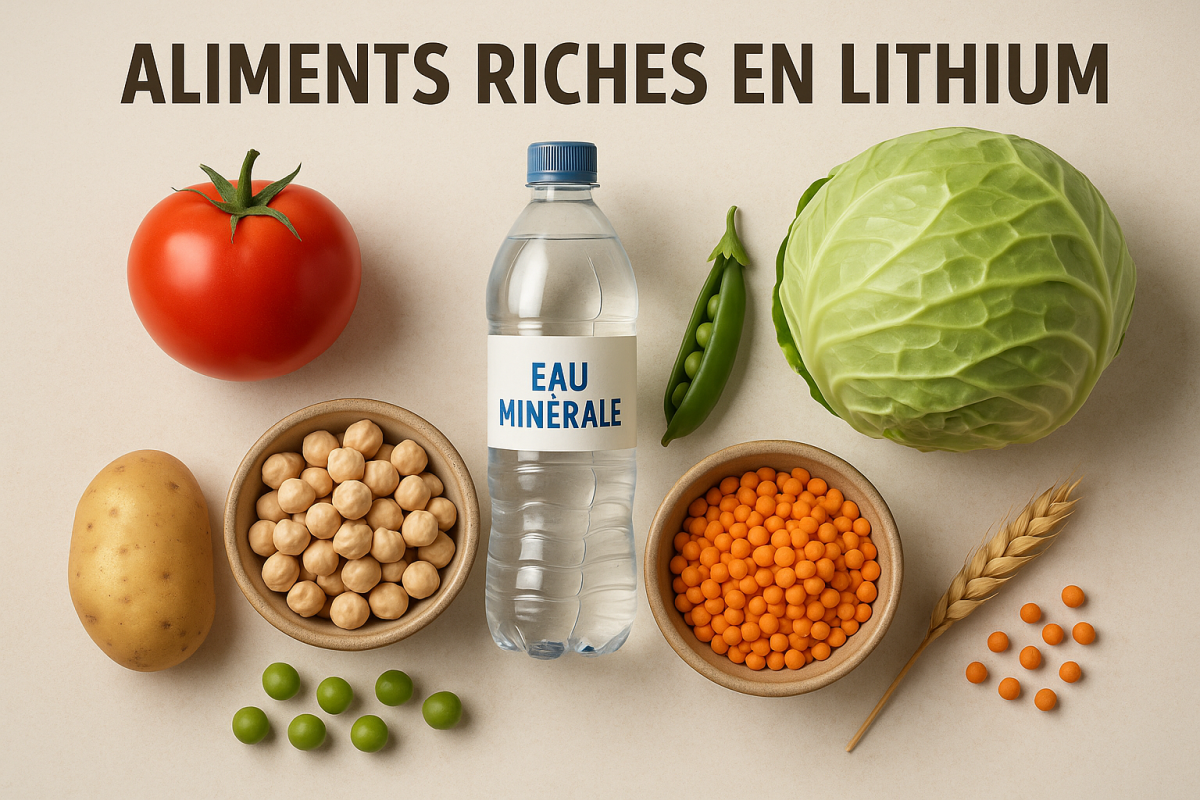
Lithium is a trace element present in trace amounts in many foods. Its content varies greatly depending on the soils, regions, and supply chains. On average, the largest dietary contributors are often:
- Legumes: peas, beans, lentils, chickpeas.
- Vegetables: potatoes, tomatoes, cabbages (high variability depending on country/soil).
- Cereals: wheat, barley, rice (especially whole grain).
- Nuts & seeds: modest but regular contributions.
- Seafood: depending on species and fishing areas.
- Mineral waters: some European thermal springs reach ~0.1 to >1 mg/L; a few special cases go higher.
There is no official recommended intake for lithium. Some publications tentatively suggest ~1 mg/day for adults, to be interpreted with caution.
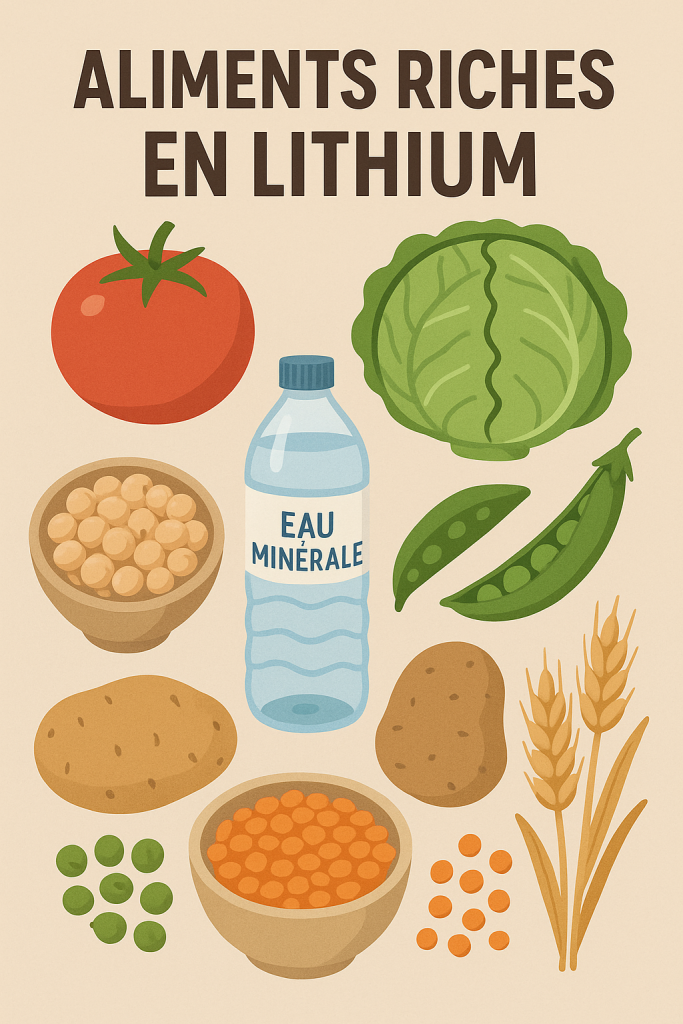
Table: orders of magnitude (foods & waters)
The figures below are indicative (units: mg of lithium per kg of food, or µg/L for water). Ranges vary depending on country, soils, varieties, brands.
| Category | Examples | Published Orders of Magnitude | Remarks |
|---|---|---|---|
| Legumes | Peas, beans, lentils, chickpeas | ≈ 1.5 – 4.2 mg/kg (e.g. peas ~4.17 mg/kg; lentils ~1.9 mg/kg) | Notable contributor in several studied countries |
| Vegetables | Tomatoes, potatoes, cabbages | Tomatoes: ~0.002 – 2.9 mg/kg; potatoes: ~0.008 – 1.5 mg/kg | Highly dependent on soils (low values in Italy, higher in Spain/Poland in some studies) |
| Cereals | Brown rice, barley, wheat | Traces to ~0.02 – 0.1+ mg/kg (depending on matrices) | Diffuse contribution (small amounts but often consumed) |
| Nuts & seeds | Hazelnuts, sunflower seeds, etc. | Traces (often a few hundredths of mg/kg) | High variability and heterogeneous data |
| Seafood | Crustaceans, mollusks | Variable contributions depending on species/areas | Possible complementary source |
| Mineral waters (high) | e.g. Vichy Catalan (Spain) | ~1.3 mg/L | Spa brands: stable contents from year to year |
| Mineral waters (low) | e.g. Evian | ~6.6 µg/L (0.0066 mg/L) | Most waters: trace level values |
| Special cases | Slovakia/Armenia (certain sources) | Up to ~5 mg/L reported | Availability varies by country |
In brief: foods mainly provide traces; mineral waters can, depending on brand and region, represent a more regular source of intake.
Practical guidelines & precautions
- Vary your plate: regularly include legumes (peas, beans, lentils), whole grains, and vegetables (potatoes, tomatoes, cabbages).
- Mineral waters: if you drink them, alternating with a naturally more lithiated brand can increase daily intake, while monitoring sodium (some highly mineralized waters contain a lot).
- No self-supplementation: medicinal lithium requires medical supervision (kidneys, thyroid, interactions). The 2025 results are promising but preclinical for humans.
- No official RDA: the ~1 mg/day guideline sometimes suggested remains exploratory and non-regulatory.
FAQ
Can drinking more lithiated mineral water “prevent” Alzheimer’s?
Observational studies suggest a link between areas with more lithiated water and lower incidence of dementia. This is not proof of causality, nor an individual clinical recommendation.
Which simple foods increase (natural) lithium intake?
Legumes, whole grains, potatoes, tomatoes, cabbages, more marginally nuts/seeds and certain seafood. The effect remains modest: we speak of trace intakes.
Can I take lithium orotate?
Avoid without medical advice. Even at low doses, lithium can present risks (kidney function, thyroid, interactions). Recent mouse studies do not automatically translate to humans.
Is there a recommended daily dose?
No. No health authority currently sets an RDA. Some authors have mentioned ~1 mg/day as exploratory.
Sources
- Nature (2025): study showing a decrease in brain lithium and benefits of lithium orotate in mice.
- Harvard Medical School (2025): review article on the study and its implications.
- Harvard Gazette (2025): popularization of the results and context.
- Nature (News & Views, 2025): commentary on the orotate vs carbonate trial.
- JAMA Psychiatry (2017): drinking water with higher lithium and dementia incidence in Denmark (non-linear relationship).
- Reviews 2023–2024 (PMC): dietary contents (legumes, vegetables, cereals) and variability by country.
- Mineral waters: Vichy Catalan ~1.3 mg/L; Evian ~6.6 µg/L; higher cases reported (Slovakia/Armenia).