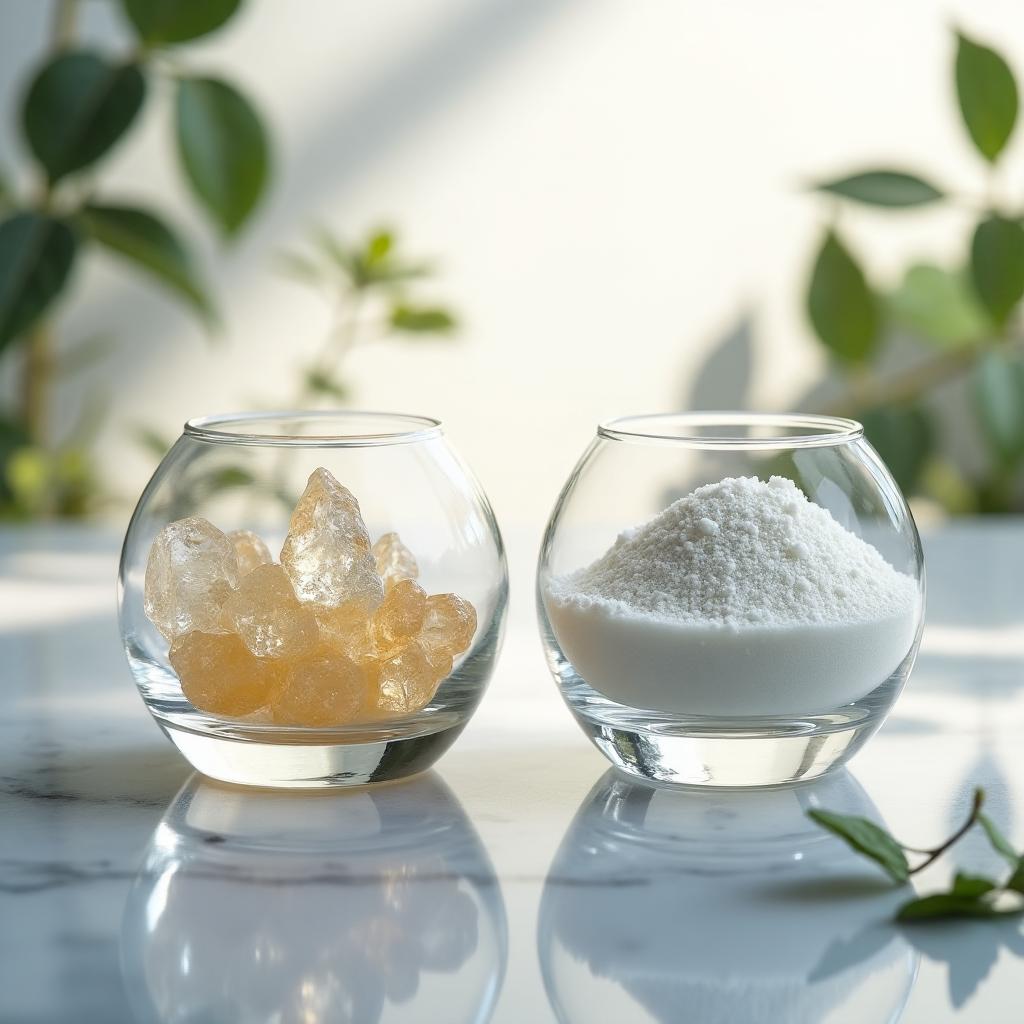
Crystallized glycine stands out for its high purity and rapid absorption, while the standard powder offers a more economical and versatile alternative. This comparison evaluates their efficacy, purity profile, and relative cost to help you determine the best option according to your budget and health goals.
📍 The crystallized format stands out with its solubility >95% and a higher purity level, ideal for those seeking efficacy.
💰 The standard powder remains more economical (up to -30% cheaper), offering a good compromise for daily use.
⚖️ On the bioavailability side, the crystalline form has a slight advantage, accelerating absorption in the small intestine.
🔎 For an informed choice, weigh your needs and your budget: each format suits a distinct user profile.
Sommaire
Principles and Forms of Glycine
Before comparing efficacy and costs, it is important to understand how these two formats are produced and what treatments they undergo.
Crystallized Glycine
Derived from a rigorous purification process, crystallized glycine appears as large white crystals. Each batch is generally tested in a laboratory to confirm a purity ≥99.9%. This form facilitates uniform dissolution without residues and is particularly suitable for pharmaceutical preparations or liquid formulas dedicated to athletes and laboratories.
Standard Powdered Glycine
Less filtered, the standard powder results from a faster mechanical drying process, sometimes leaving micro-particles or impurities. Its fine grain easily integrates into smoothies, capsules, or homemade energy bars. Although its purity generally ranges around 98–99%, its more attractive price largely compensates for this difference for the general public.
Efficacy and Bioavailability
Let’s immediately compare absorption and feedback to measure the concrete impact of each format.
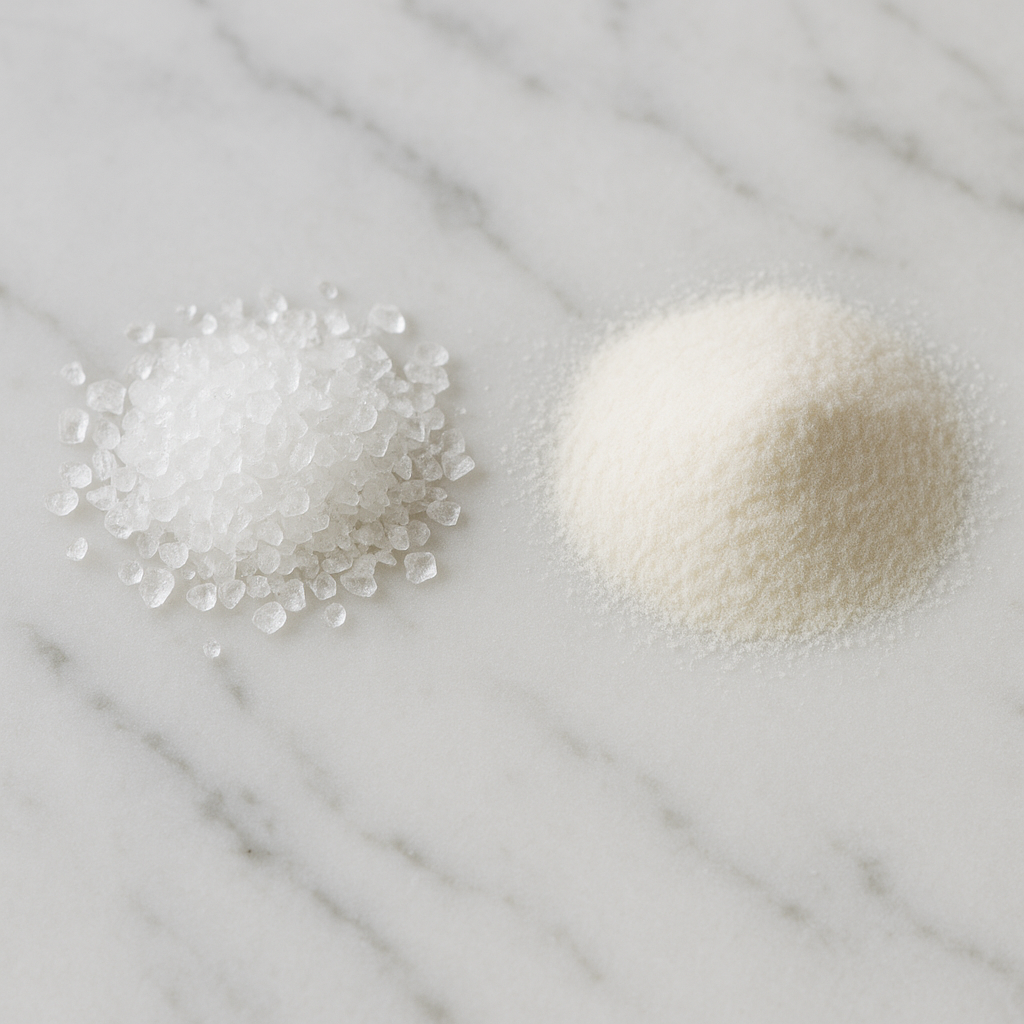
Absorption and Digestion
The crystalline structure facilitates the molecule’s penetration into the intestinal lumen. According to a study from the University of California, crystallized glycine reaches a bioavailability of 95%, compared to 80% for the standard powder. In practice, this translates into a faster circulatory peak and increased efficacy from the moment of intake.
Clinical Studies and Feedback
Several clinical trials (Journal of Nutrition, 2019) confirm a significant advantage of the crystallized form in high-level athletes. However, user testimonials show that for moderate daily use, the standard powder remains perfectly satisfactory, especially for dietary or relaxing use.
Purity and Quality Profile
Beyond solubility, it is the guarantee of absence of contaminants and the transparency of labels that determine the overall quality.
Contaminant Analysis
Heavy metal tests (arsenic, lead) generally reveal lower traces in crystallized glycine, thanks to double filtration. The standard powder, despite controls compliant with standards, may show slightly higher levels, without exceeding authorized thresholds.
Label and Traceability
NSF or USP certifications are more common on crystallized glycine, reassuring regarding the production chain and regular audits. To develop a complete strategy, consider combining dietary supplements and strengthening your winter protocol without compromise.
Price and Quality-Price Ratio
When purchasing, the issue remains the cost per dose and long-term savings.
Cost per Dose
| Format | Price/100 g | Standard Dose (5 g) | Cost/Dose |
|---|---|---|---|
| Crystallized Glycine | €15 | 5 g | €0.75 |
| Standard Powder | €10 | 5 g | €0.50 |
Long-Term Investment
Consider your usage frequency: an athlete consuming 15 g per day may find the price difference significant, while occasional commuter use may favor the standard powder without regrets.
FAQ
- Which form to choose for intensive sports use?
Crystallized glycine maximizes absorption and limits possible digestive issues related to impurities. - Does the standard powder pose a health risk?
No, usual controls guarantee a compliant purity level, perfect for classic use. - How to dose glycine?
Count 3 to 5 g for a relaxing effect, up to 15 g for muscle recovery protocols. - Can glycine be mixed with hot drinks?
Yes, crystallized glycine dissolves without lumps even at high temperature. - What is the taste impact?
Both formats are neutral, but the crystallized offers a cleaner dissolution without residual powdery texture.